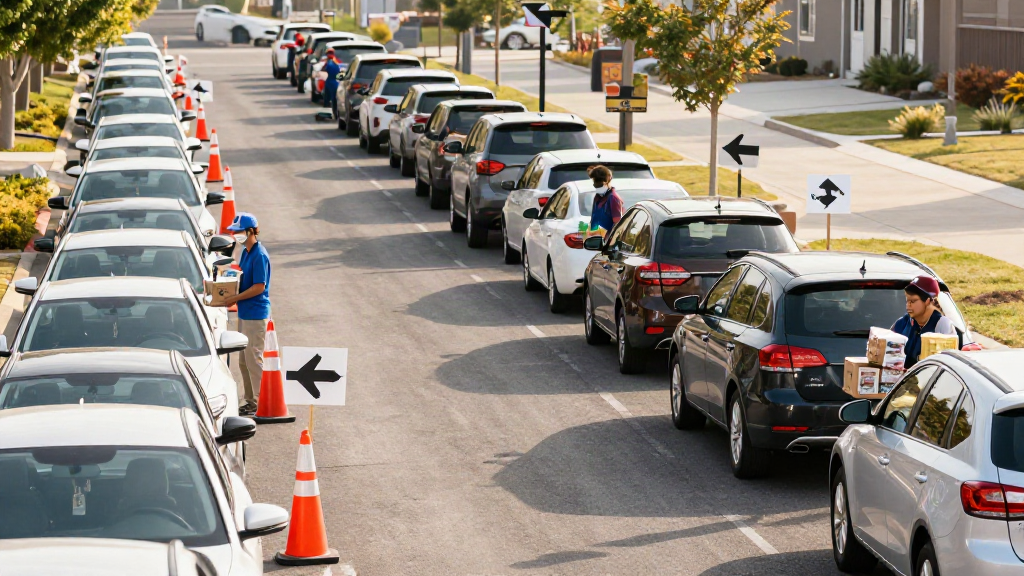
A drive-through food pantry distribution should feel calm. Families pull in, get what they need, and pull out. Nobody should sit in a line for an hour wondering whether they will be turned away. When the line stretches down the block, it is almost never because your volunteers are slow. It is because the flow was never mapped, and the same few steps are doing all the work of holding everything up.
This guide walks through a practical way to run a drive-through food pantry distribution without long lines. It covers how to map your distribution flow before cars arrive, how to set up check-in that takes seconds instead of minutes, and how to keep the lane moving when something inevitably stalls. None of it requires a big budget or a technical team. It just requires deciding where each step happens, and in what order.
Map Your Distribution Flow Before the First Car Arrives
The most common cause of a long line is a bottleneck that lives in the wrong place. If every car stops at one table to be verified, chosen for, packed, and handed food, then that one table sets your pace. Ten cars can pass through it cleanly. A hundred cannot.
Walk the lot before you open and sketch the whole route on paper. Draw where cars enter, where they stop, where they exit, and every point in between where a volunteer touches the car. Then ask a simple question about each stop: does the car need to be here for this? Every stop you can move off the lane, move off the lane.
Most pantries get faster when they split the work into stages:
A greeting stop where a volunteer confirms the car is in the right place and hands over a number or a queue card
A check-in stop where the household is verified and their order is confirmed
A packing stop where the boxes are already made and simply loaded
An exit path that never crosses back through the line
The goal is a single forward path with no backtracking. When a car has to reverse, or when volunteers have to walk into the lane to retrieve something, you lose several seconds per car. Across a hundred cars, that is the difference between a smooth morning and a long afternoon.
It also helps to set up staging in advance. Pack standard boxes before the lot opens. Put the most common items closest to the loading point. Store the rare items somewhere out of the driving path so a volunteer can fetch them without stepping in front of a car. Staging is invisible to families, but it is the quiet reason a distribution feels effortless.
Set Up Fast Client Check-In So Each Family Is Verified in Seconds
The check-in stop is where drive-through lines go to die. A paper intake form with the same fields copied by hand, a binder that has to be flipped through, handwriting that has to be read twice - each of these adds a minute or more per car. Ten cars is fine. Fifty cars is a traffic jam.
Fast check-in comes down to three things: the information is already there, the volunteer can find it quickly, and repeat visitors do not start from zero.
If your household records live on paper or in a spreadsheet, the quickest upgrade is to get them into a system where a name or phone number pulls up the full record. A returning family should be confirmable in a few seconds, with their past visits and usual order already on screen. New families should be added in a single short form that a volunteer can complete while the previous car pulls away.
Design the check-in stop around the volunteer, not around the software. The screen should show one clear action at a time. If a first-time volunteer needs a training session to complete a check-in, the process will slow down every time someone new takes the table. The test is simple: can a volunteer who has never seen the tool verify a family correctly on their first try, with a coordinator nearby but not hovering?
Text alerts are another quiet fix. When families receive a reminder before the distribution, they arrive more evenly spaced, and questions get answered before they reach the lane. Fewer surprises at the window means less time parked in park.
One caution: keep check-in private. Household information should be visible only to the volunteer who needs it, and nothing should be shouted across the lot. Speed matters, but dignity matters more, and the two are not in conflict when the process is built well.
Keep the Lane Moving With Volunteer Roles and Queue Visibility
A line moves when every volunteer knows exactly one job. When roles are vague, people drift toward whatever looks busiest, and the lane loses its rhythm. Assign roles before you open, and write them down.
A workable set of roles for a drive-through distribution:
A traffic lead who owns the lane and the pace, and who can wave a car forward or hold it back
Greeters who confirm each car is in the right place and hand out queue cards
Check-in volunteers who verify households and confirm orders
Packers or loaders who bring boxes to the window
A floater who covers breaks, handles exceptions, and restocks staging
Queue visibility is what lets the traffic lead do their job. If nobody can see how many cars are waiting or which stop is backed up, the lead is guessing. A simple shared view of the current line, updated as cars move through, turns guesswork into a decision. That is exactly the kind of thing a pantry-day queue is built for: everyone sees the same picture, so the floater can be sent to the stop that is falling behind instead of the stop that just looks busy.
Give the traffic lead authority to pause intake. If the lane is backing up onto a public road, the right move is to slow the entrance, not to rush the check-in. A controlled trickle keeps families safe and keeps volunteers from making mistakes under pressure.
Build Simple Backup Steps for When Something Stalls
Something will stall. A printer will run out of paper, a volunteer will need to step away, or a family will arrive with a situation nobody planned for. The pantries that stay calm are the ones that decided in advance what to do.
Keep a short written backup plan at the check-in table. It might include a paper fallback form for when the system is slow, a named person to call when a record cannot be found, and a simple rule for what to do when the line exceeds a set length. Five lines on an index card beat an improvised discussion in the middle of the lane.
Practice the handoff. The moment a volunteer leaves, the next person should be able to take the table without a briefing. When the process lives in one person's head, a break becomes a bottleneck.
After the distribution, spend ten minutes writing down what actually slowed you down. Was it check-in? A missing item? Cars arriving before staging was ready? Keep the notes short, and fix the single biggest cause before the next distribution. Small, steady fixes compound faster than a full redesign.
Where PantryOS Fits
None of this requires heavy software, but the right tools make the steps easier to hold together. PantryOS is built for exactly this kind of day: fast client check-in so a household is verified in seconds, a pantry-day queue that gives every volunteer the same view of the lot, inventory that stays accurate as boxes leave, and family text alerts that space out arrivals. Volunteer coordination and simple outcome reporting mean the numbers you need for your board are already collected, without a second round of data entry.
It is designed to be picked up by non-technical volunteers, with data kept private and support from real people when you need it.
The Takeaway
A drive-through food pantry distribution runs without long lines when you decide, in advance, where each step happens and who owns it. Map the flow. Move work off the lane. Make check-in fast and private. Give every volunteer one clear job and the lead a live view of the queue. Then keep a short backup plan for the days that do not go to plan.
Your pantry should not run on paperwork and guesswork. Map it once, and every distribution after that gets a little smoother.